

Detectors#
Response functions#
- kornia.feature.gftt_response(input, grads_mode='sobel', sigmas=None)[source]#
Compute the Shi-Tomasi cornerness function.

The function does no non-maxima suppression. The response map is computed according to the following formulation:
\[R = min(eig(M))\]where \(M\) is the windowed structure tensor of
harris_response(), with the same gradients and window.- Convention:
\(R\) is not negative, up to roundoff. It is large at a corner and near zero along an edge, where the Harris response is negative.
Multiplying the image by
cmultiplies the response byc ** 2, and an offset does not change it.sigmasmultiplies the response bysigmas ** 4, the same power used byharris_response(). This is the function’s scale-weighting convention, not a guarantee of scale invariance. The integration window \(W\) stays fixed as the image blur changes; the response’s decay with blur depends on the image structure, including the corner geometry.
- Parameters:
input (
Tensor) – input image with shape \((B, C, H, W)\).grads_mode (
str, optional) – can be'sobel'for standalone use or'diff'for use on Gaussian pyramid. Default:"sobel"sigmas (
Optional[Tensor], optional) – per-image scales with shape \((B)\). The response of imagebis multiplied bysigmas[b] ** 4, so that non-maxima suppression can compare the levels of a scale pyramid. Default:None
- Return type:
- Returns:
the response map per channel with shape \((B, C, H, W)\).
Example
>>> input = torch.tensor([[[
...    [0., 0., 0., 0., 0., 0., 0.],
...    [0., 1., 1., 1., 1., 1., 0.],
...    [0., 1., 1., 1., 1., 1., 0.],
...    [0., 1., 1., 1., 1., 1., 0.],
...    [0., 1., 1., 1., 1., 1., 0.],
...    [0., 1., 1., 1., 1., 1., 0.],
...    [0., 0., 0., 0., 0., 0., 0.],
... ]]])  # 1x1x7x7
>>> # compute the response map; rounded for a platform-stable display
>>> gftt_response(input).round(decimals=4) + 0.0
tensor([[[[0.0379, 0.0456, 0.0283, 0.0121, 0.0283, 0.0456, 0.0379],
          [0.0456, 0.0598, 0.0402, 0.0168, 0.0402, 0.0598, 0.0456],
          [0.0283, 0.0402, 0.0545, 0.0245, 0.0545, 0.0402, 0.0283],
          [0.0121, 0.0168, 0.0245, 0.0276, 0.0245, 0.0168, 0.0121],
          [0.0283, 0.0402, 0.0545, 0.0245, 0.0545, 0.0402, 0.0283],
          [0.0456, 0.0598, 0.0402, 0.0168, 0.0402, 0.0598, 0.0456],
          [0.0379, 0.0456, 0.0283, 0.0121, 0.0283, 0.0456, 0.0379]]]])
- kornia.feature.harris_response(input, k=0.04, grads_mode='sobel', sigmas=None)[source]#
Compute the Harris cornerness function.

The function does no non-maxima suppression. The response map is computed according to the following formulation:
\[R = det(M) - k \cdot trace(M)^2\]where \(w\) are the weights of a window \(W\):
\[\begin{split}M = \sum_{(x,y) \in W} w(x, y) \begin{bmatrix} I^{2}_x & I_x I_y \\ I_x I_y & I^{2}_y \\ \end{bmatrix}\end{split}\]and \(k\) is an empirically determined constant, usually in \([0.04, 0.06]\).
- Convention:
\(R\) is signed and not clamped: positive at a corner, negative along an edge.
\(I_x\) and \(I_y\) come from
spatial_gradient()withmode=grads_mode, in intensity per pixel for both modes, and \(W\) is a \(7 \times 7\) Gaussian window of \(\sigma = 1\) whose weights sum to one. A linear ramp of gradient \(g\) therefore gives \(R = -k \|g\|^4\) away from the border.Apart from
sigmas, the response depends on the image’s intensity scale: multiplying the image bycmultiplies the response byc ** 4, and an offset does not change it, so a threshold tuned on images in[0, 1]does not carry over to[0, 255].kis not validated.
- Parameters:
input (
Tensor) – input image with shape \((B, C, H, W)\).k (
Union[Tensor,float], optional) – the Harris detector free parameter. Default:0.04grads_mode (
str, optional) – can be'sobel'for standalone use or'diff'for use on Gaussian pyramid. Default:"sobel"sigmas (
Optional[Tensor], optional) – per-image scales with shape \((B)\). The response of imagebis multiplied bysigmas[b] ** 4, so that non-maxima suppression can compare the levels of a scale pyramid, as in vlfeat. Default:None
- Return type:
- Returns:
the response map per channel with shape \((B, C, H, W)\).
Example
>>> input = torch.tensor([[[
...    [0., 0., 0., 0., 0., 0., 0.],
...    [0., 1., 1., 1., 1., 1., 0.],
...    [0., 1., 1., 1., 1., 1., 0.],
...    [0., 1., 1., 1., 1., 1., 0.],
...    [0., 1., 1., 1., 1., 1., 0.],
...    [0., 1., 1., 1., 1., 1., 0.],
...    [0., 0., 0., 0., 0., 0., 0.],
... ]]])  # 1x1x7x7
>>> # compute the response map; rounded for a platform-stable display
>>> harris_response(input, 0.04).round(decimals=4) + 0.0
tensor([[[[0.0042, 0.0054, 0.0035, 0.0006, 0.0035, 0.0054, 0.0042],
          [0.0054, 0.0068, 0.0046, 0.0014, 0.0046, 0.0068, 0.0054],
          [0.0035, 0.0046, 0.0034, 0.0014, 0.0034, 0.0046, 0.0035],
          [0.0006, 0.0014, 0.0014, 0.0006, 0.0014, 0.0014, 0.0006],
          [0.0035, 0.0046, 0.0034, 0.0014, 0.0034, 0.0046, 0.0035],
          [0.0054, 0.0068, 0.0046, 0.0014, 0.0046, 0.0068, 0.0054],
          [0.0042, 0.0054, 0.0035, 0.0006, 0.0035, 0.0054, 0.0042]]]])
- kornia.feature.hessian_response(input, grads_mode='sobel', sigmas=None)[source]#
Compute the determinant of the Hessian matrix.

The function does no non-maxima suppression. The response map is computed according to the following formulation:
\[R = det(H)\]where:
\[\begin{split}H = \begin{bmatrix} I_{xx} & I_{xy} \\ I_{xy} & I_{yy} \\ \end{bmatrix}\end{split}\]- Convention:
\(R = I_{xx} I_{yy} - I_{xy}^2\) is signed and pointwise, without a window: positive at bright and dark blobs alike, negative at a saddle. The second derivatives come from
spatial_gradient()withmode=grads_modeandorder=2.Multiplying the image by
cmultiplies the response byc ** 2, and an offset does not change it.
- Parameters:
input (
Tensor) – input image with shape \((B, C, H, W)\).grads_mode (
str, optional) – can be'sobel'for standalone use or'diff'for use on Gaussian pyramid. Default:"sobel"sigmas (
Optional[Tensor], optional) – per-image scales with shape \((B)\). The response of imagebis multiplied bysigmas[b] ** 4, so that non-maxima suppression can compare the levels of a scale pyramid. Default:None
- Return type:
- Returns:
the response map per channel with shape \((B, C, H, W)\).
- Shape:
Input: \((B, C, H, W)\)
Output: \((B, C, H, W)\)
Examples
>>> input = torch.tensor([[[
...    [0., 0., 0., 0., 0., 0., 0.],
...    [0., 1., 1., 1., 1., 1., 0.],
...    [0., 1., 1., 1., 1., 1., 0.],
...    [0., 1., 1., 1., 1., 1., 0.],
...    [0., 1., 1., 1., 1., 1., 0.],
...    [0., 1., 1., 1., 1., 1., 0.],
...    [0., 0., 0., 0., 0., 0., 0.],
... ]]])  # 1x1x7x7
>>> # compute the response map; rounded for a platform-stable display
>>> hessian_response(input).round(decimals=4) + 0.0
tensor([[[[-0.0137, -0.0332, -0.0205,  0.0000, -0.0205, -0.0332, -0.0137],
          [-0.0332,  0.0098,  0.0381,  0.0000,  0.0381,  0.0098, -0.0332],
          [-0.0205,  0.0381,  0.0547,  0.0000,  0.0547,  0.0381, -0.0205],
          [ 0.0000,  0.0000,  0.0000,  0.0000,  0.0000,  0.0000,  0.0000],
          [-0.0205,  0.0381,  0.0547,  0.0000,  0.0547,  0.0381, -0.0205],
          [-0.0332,  0.0098,  0.0381,  0.0000,  0.0381,  0.0098, -0.0332],
          [-0.0137, -0.0332, -0.0205,  0.0000, -0.0205, -0.0332, -0.0137]]]])
- kornia.feature.dog_response(input)[source]#
Compute the Difference-of-Gaussian response.
- Convention:
Output level
iisinput[:, :, i + 1] - input[:, :, i]along the level axisD(dim 2), soDlevels giveD - 1. For a stack blurred from fine to coarse, this is Lowe’s \(L(k\sigma) - L(\sigma)\): negative at a bright blob, positive at a dark one.
- kornia.feature.dog_response_single(input, sigma1=1.0, sigma2=1.6)[source]#
Compute the Difference-of-Gaussian response.

- Convention:
Returns the Gaussian blur of
sigma2minus that ofsigma1, the order ofdog_response(); see its Convention block. Each kernel has the sizeint(8 * sigma + 1), rounded up to an odd number. The order ofsigma1andsigma2is not checked: swapping them flips the sign.
- class kornia.feature.BlobHessian(grads_mode='sobel')[source]#
nn.Module that calculates Hessian blobs.
- Convention:
Returns
hessian_response()with the constructor’sgrads_mode; see its Convention block.
- class kornia.feature.CornerGFTT(grads_mode='sobel')[source]#
nn.Module that calculates Shi-Tomasi corners.
- Convention:
Returns
gftt_response()with the constructor’sgrads_mode; see its Convention block.
- class kornia.feature.CornerHarris(k, grads_mode='sobel')[source]#
nn.Module that calculates Harris corners.
- Convention:
Returns
harris_response()with the constructor’skandgrads_mode; see its Convention block. Unlike the function’s, thiskhas no default.
- class kornia.feature.BlobDoG[source]#
nn.Module that calculates Difference-of-Gaussians blobs.
- Convention:
Returns
dog_response()of the \((B, C, D, H, W)\) scale stack; see its Convention block.sigmasis ignored.
- class kornia.feature.BlobDoGSingle(sigma1=1.0, sigma2=1.6)[source]#
nn.Module that calculates Difference-of-Gaussians blobs.
- Convention:
Returns
dog_response_single()with the constructor’ssigma1andsigma2; see its Convention block.sigmasis ignored.
Detectors#
- class kornia.feature.KeyNet(pretrained=True, keynet_conf=None)[source]#
Key.Net model definition – local feature detector (response function).
This is based on the original code from paper “Key.Net: Keypoint Detection by Handcrafted and Learned CNN Filters”. See [BLRPM19] for more details.

- Convention:
The input is a grayscale image, and the pretrained weights expect it in
[0, 1], as the Key.Net reference scales its images. The response is not proportional to the intensity, so an image in[0, 255]gives other detections.The response is a non-negative map of the input’s size.
- Parameters:
pretrained (
bool, optional) – Download and set pretrained weights to the model. Default:Truekeynet_conf (
Optional[KeyNet_conf], optional) – Dict with initialization parameters. Do not pass it, unless you know what you are doing. Anum_filters,num_levelsorkernel_sizeother than the default changes the architecture: passpretrained=Falsewith it, since the strict load of the weights raisesRuntimeError. Default:None
- Returns:
KeyNet response score.
- Shape:
Input: \((B, 1, H, W)\)
Output: \((B, 1, H, W)\)
- class kornia.feature.MultiResolutionDetector(model, num_features=2048, config=None, ori_module=None, aff_module=None, compile_model=False, score_threshold=0.0)[source]#
Multi-scale feature detector, based on KeyNet, for a response function that returns one map of its input’s size.
This is based on the original code from paper “Key.Net: Keypoint Detection by Handcrafted and Learned CNN Filters”. See [BLRPM19] for more details.
The Key.Net reference code zeroes a 15 px strip along each side of a level before the non-maxima suppression, which reports a “maximum” beside the strip wherever the response rises into it. This detector suppresses on the whole response and removes the strip from the suppression output instead; see
detect_features_on_single_level().- Convention:
Detections are maxima of the response above
score_threshold. For a signed response whose minima are features as well, such as a difference of Gaussians, pass its magnitude, asSIFTFeaturedoes.A detection is an integer pixel \((u, v)\) of a pyramid level of size \((H_l, W_l)\), without a sub-pixel step. It is reported at \((u W / W_l, v H / H_l)\) of the \((H, W)\) input, in the frame of
laf_from_center_scale_ori()(see Local features), and not at the level pixel’s centre \(((u + 0.5) W / W_l - 0.5, (v + 0.5) H / H_l - 0.5)\); the Key.Net reference maps it the same way.Before
aff_moduleandori_modulerun, the frame is upright and isotropic, with the scales_mult * (W / W_l + H / H_l) / 2whatever the response;s_multofconfigis 22 by default.
- Parameters:
model (
Module) – response function, such as KeyNet or BlobHessiannum_features (
int, optional) – Number of features to detect. Every pyramid level is searched for this many candidates and the whole set is ranked together, so the result is thenum_featureshighest responses in the image, and the sorted response vector for one value is a prefix of the vector for any larger one. Which detection carries a given response is not pinned when responses tie:topkbreaks a tie by position, and the positions it ranks over depend onnum_features. Default:2048config (
Optional[Detector_config], optional) – Dict with initialization parameters. Do not pass it, unless you know what you are doing. Default:Noneori_module (
Optional[Module], optional) – for local feature orientation estimation. Default:PassLAF, which does nothing. SeeLAFOrienterfor details.aff_module (
Optional[Module], optional) – for local feature affine shape estimation. Default:PassLAF, which does nothing. SeeLAFAffineShapeEstimatorfor details.compile_model (
bool, optional) – wrap the response function and the non-maxima suppression withtorch.compile(). Default:Falsescore_threshold (
float, optional) – minimum response for a position to count as a detection. Must be non-negative: non-maxima suppression writes an exact zero at every suppressed position, so a negative threshold would admit all of them. Default:0.0
- detect(img, mask=None)[source]#
Detect local features in an image batch.
- Parameters:
img (
Tensor) – Input image tensor with shape (1, C, H, W).mask (
Optional[Tensor], optional) – Optional mask with shape (1, 1, H, W) saying where a detection may be. A boolean or integer mask is binary (any non-zero value keeps a position), a floating-point mask is used as weights on the detection scores: a weight in (0, 1] scales a score toward the worst, so a down-weighted maximum never outranks a full-weight one, and a zero or negative weight suppresses. Weights above one are clamped to one, so a float 0/255 mask means what the integer one means. The weights are cast to the image dtype. The mask is resampled onto every pyramid level conservatively, so a zero region suppresses every maximum within one level pixel of it. Default:None
- Return type:
- Returns:
Tuple containing detection scores and local affine frames, shaped (1, num_features) and (1, num_features, 2, 3), holding the num_features highest responses in the image and sorted by response, descending. The shape holds even when the image yields fewer above-threshold maxima than requested: those slots carry a zero response and a zero LAF, and sort after every real detection. The LAFs are float32 for a float16 or bfloat16 image and float64 for a float64 one; the responses keep the response function’s dtype.
- detect_features_on_single_level(level_img, num_kp, factor, *, mask=None)[source]#
Detect keypoints on one image-pyramid level.
The response function may consume a multi-channel image – for example, a learned color detector – but must return one response map. A LAF has no response-channel identity, so independent per-channel detections are ambiguous and rejected.
ScaleSpaceDetectorfollows the same contract.A detection is a strict maximum of the response over its
nms_sizewindow, abovescore_threshold, that lies outside the 15 px strip along the level’s sides. The suppression reads the whole response, the strip included, andremove_borders()then zeroes the strip in its output: a position beside the strip is reported only when no response at least as strong, inside the strip or not, lies within its window.- Parameters:
level_img (
Tensor) – Image tensor for a single pyramid level.num_kp (
int) – Number of keypoints requested from this pyramid level.factor (
Tuple[float,float]) – Per-axis factor(W / W_l, H / H_l)from the current pyramid level to the original image: level pixel \((u, v)\) is reported at(u * factor[0], v * factor[1]).mask (
Optional[Tensor], optional) – Optional mask with shape \((1, 1, H, W)\) at the original image resolution, saying where a detection may be. It is resampled onto this level conservatively and applied to the non-maxima suppression output, so a zero region drops every maximum within one level pixel of it and a floating-point weight scales the score. Keyword-only. Default:None
- Return type:
- Returns:
Tuple containing scores and local affine frames detected at the requested pyramid level, with
min(num_kp, H * W)slots. When the level holds fewer above-threshold maxima than that, the remaining slots are padded with a zero response and a zero LAF.
- forward(img, mask=None)[source]#
Three stage local feature detection.
First the location and scale of interest points are determined by detect function. Then affine shape and orientation.
- Parameters:
img (
Tensor) – image to extract features with shape [1xCxHxW]. Only a batch of one image is accepted.mask (
Optional[Tensor], optional) – a mask saying where a detection may be, shape [1x1xHxW]. A boolean or integer mask is binary, a floating-point mask weights the detection scores; seedetect(). Default:None
- Return type:
- Returns:
Tuple of
lafswith shape [1xNx2x3], the detected local affine frames, andresponseswith shape [1xN], the response function values for the corresponding lafs. When the image yields fewer above-threshold maxima thannum_features, the remaining slots hold a zero response and a zero LAF, whichever affine-shape and orientation modules are configured.
- remove_borders(score_map, borders=15)[source]#
Zero the strip of
borderspixels along each side of a level, so that no detection is made there.detect_features_on_single_level()applies it to the non-maxima suppression output, not to the response, so an override receives the suppressed map. The strip is set to an exact zero whatever the score there, an infinite one included.- Return type:
- class kornia.feature.ScaleSpaceDetector(num_features=500, mr_size=6.0, scale_pyr_module=None, resp_module=None, subpix_module=None, ori_module=None, aff_module=None, minima_are_also_good=False, scale_space_response=False, compile_modules=False)[source]#
nn.Module for differentiable local feature detection.
It has 5 modules inside: scale pyramid generator, response (“cornerness”) function, sub-pixel localization, affine shape estimator and patch orientation estimator. Each of those modules could be replaced with a learned custom one, as long as they respect output shape.
- Convention:
The candidates are the strict \(3 \times 3 \times 3\) maxima of the response over level, row and column (
nms3d_minmax()) on the levels given underscale_pyr_module, whatever their sign. Withminima_are_also_gooda strict minimum is a candidate too when its negated response after sub-pixel refinement exceeds the response the maxima pass reports at that voxel, which the built-in refiners leave at its sampled value: in effect every minimum below zero, and a minimum above zero only when the refinement extrapolates it below minus its sampled value. There is no response threshold. Thenum_featuresstrongest candidates of all octaves are kept; a minimum is ranked and returned with its refined response negated.The default Hessian response is a maximum at bright and dark blobs alike. A DoG response (
BlobDoG) is a maximum at a dark blob and a minimum at a bright one, which onlyminima_are_also_good=Truedetects.A LAF centre is the refined sub-pixel position, mapped to input pixels as given under
scale_pyr_module, in the frame oflaf_from_center_scale_ori()(see Local features). Beforeaff_moduleandori_modulerun, the frame is diagonal:mr_sizetimes the detection scale, mapped to input pixels along each axis like the centre.A candidate is kept when half its frame lies at least 5 octave pixels inside the octave’s outer pixel centres; the whole frame can reach outside the image.
The output has
num_featuresslots: the detections by decreasing response, then the unfilled slots, which hold a zero response and a zero LAF.The LAFs are float32 for a float16 or bfloat16 image and float64 for a float64 one; the responses keep the response function’s dtype. Non-maximum suppression and sub-pixel refinement run on the response promoted to at least float32.
A batch of zero images returns empty outputs of the documented shapes, after the checks a non-empty batch runs.
Known defects: an octave passes only its
num_featuresstrongest candidates to the border test and to the mask check of their refined centres, so the slot of a candidate rejected there stays empty even when a weaker valid candidate exists (#5741).
- Parameters:
num_features (
int, optional) – Number of features to detect. In order to keep everything batchable, output would always have num_features output, even for completely homogeneous images. Default:500mr_size (
float, optional) – multiplier from the detection scale to the LAF scale. The default 6.0 gives a frame of about six times the \(\sigma\) of a detected Gaussian blob. Default:6.0scale_pyr_module (
Optional[Module], optional) – generates scale pyramid. SeeScalePyramidfor details. Default:ScalePyramid(3, 1.6, 16, extra_levels=3)with a scale-space response,extra_levels=2without. A detection at octave pixel \((u, v)\) is reported at \((u (W - 1) / (W_o - 1), v (H - 1) / (H_o - 1))\) in the input, the map ofScalePyramid’salign_corners=Trueresizes; a custom pyramid has to resize the same way. Each octave searchesn_levelsresponse levels, levels1..n_levels; the levels below and above them are NMS neighbours only, and any further level is ignored. A per-level response therefore needsextra_levels >= 2, and DoG, which has one level fewer than its pyramid,extra_levels >= 3.resp_module (
Optional[Module], optional) – calculates'cornerness'of the pixel. Default:BlobHessian.subpix_module (
Optional[Module], optional) – refines the position and scale of each candidate to sub-pixel / sub-scale accuracy. The candidates are those of the Convention block, whatever the module. Default:AdaptiveQuadInterp3dwithallow_scale_steps=True.ori_module (
Optional[Module], optional) – for local feature orientation estimation. Default:PassLAF, which does nothing. SeeLAFOrienterfor details.aff_module (
Optional[Module], optional) – for local feature affine shape estimation. Default:PassLAF, which does nothing. SeeLAFAffineShapeEstimatorfor details.minima_are_also_good (
bool, optional) – if True, then both response function minima and maxima are detected. A DoG response needs it to detect bright blobs. Default is False. With a built-insubpix_moduleboth signs are refined in one stacked call, which roughly doubles the peak memory of the refinement step: the response volume and its three coordinate maps are materialised for2Bimages at once. Default:Falsescale_space_response (
bool, optional) – if True,resp_modulegets each whole octave \((B, C, L, H, W)\) with its sigmas \((B \cdot L)\) and returns a \((B, 1, L', H, W)\) scale-space response, asBlobDoGdoes. If False (the default), it gets the octave’s levels0 .. n_levels + 1as \((B \cdot L, C, H, W)\) images, \(L = n_{levels} + 2\), with their sigmas and returns \((B \cdot L, 1, H, W)\). Default:Falsecompile_modules (
Union[bool,List[str]], optional) – selects which sub-modules to wrap withtorch.compile(). PassTrueto compile every sub-module,False(default) for none, or a list containing any subset of["scale_pyr", "resp", "subpix", "ori", "aff"]. Compilingsubpixfuses the iteration loop ofconv_quad_interp3d(), which the defaultAdaptiveQuadInterp3druns on CUDA. The first call incurs a one-time compilation cost; subsequent calls are fast. Default:False
- detect(img, num_feats, mask=None)[source]#
Detect local features in an image batch.
- Parameters:
img (
Tensor) – Input image tensor with shape (B, C, H, W).num_feats (
int) – Number of features requested from the detector.mask (
Optional[Tensor], optional) – Optional mask with shape (1 or B, 1, H, W) saying where a detection may be. A boolean or integer mask is binary (any non-zero value keeps a position), a floating-point mask is used as weights on the detection scores: a weight in (0, 1] scales a score toward the worst (a non-negative score is multiplied by it, a negative one divided), so a down-weighted candidate never outranks a full-weight one, and a zero or negative weight suppresses. Weights above one are clamped to one, so a float 0/255 mask means what the integer one means. The weights are cast to the image dtype. The mask is resampled onto every octave conservatively, so a zero region suppresses every candidate within one octave pixel of it. Default:None
- Return type:
- Returns:
Tuple containing detection scores and local affine frames, shaped (B, num_feats) and (B, num_feats, 2, 3). A slot that no detection filled – there were fewer candidates than requested, or the border or mask test rejected a candidate – carries a zero response and a zero LAF, and sorts after every real detection. The converse does not hold: a signed response function can peak at exactly zero, and that slot keeps its frame. A batch of zero images returns empty outputs of these shapes.
- forward(img, mask=None)[source]#
Three stage local feature detection.
First the location and scale of interest points are determined by detect function. Then affine shape and orientation.
- Parameters:
- Return type:
- Returns:
Tuple of
lafswith shape [BxNx2x3], the detected local affine frames, andresponseswith shape [BxN], the response function values for the corresponding lafs. When an image yields fewer maxima thannum_features, the remaining slots hold a zero response and a zero LAF, whichever affine-shape and orientation modules are configured.
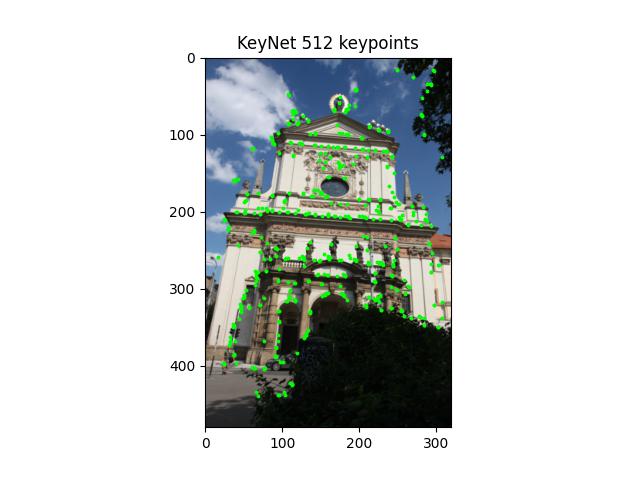
- class kornia.feature.KeyNetDetector(pretrained=True, num_features=2048, keynet_conf=None, ori_module=None, aff_module=None, compile_model=False, score_threshold=0.0)[source]#
Multi-scale feature detector based on KeyNet.
This is based on the original code from paper “Key.Net: Keypoint Detection by Handcrafted and Learned CNN Filters”. See [BLRPM19] for more details.
- Convention:
A
MultiResolutionDetectorwithKeyNetas its response; see their Convention blocks for the frame of the detections and for the input range.
- Parameters:
pretrained (
bool, optional) – Download and set pretrained weights to the model. Default:Truenum_features (
int, optional) – Number of features to detect. Default:2048keynet_conf (
Optional[KeyNet_conf], optional) – Dict with initialization parameters. Do not pass it, unless you know what you are doing. Anum_filters,num_levelsorkernel_sizeother than the default changes the architecture: passpretrained=Falsewith it, since the strict load of the weights raisesRuntimeError. Default:Noneori_module (
Optional[Module], optional) – for local feature orientation estimation. Default:PassLAF, which does nothing. SeeLAFOrienterfor details.aff_module (
Optional[Module], optional) – for local feature affine shape estimation. Default:PassLAF, which does nothing. SeeLAFAffineShapeEstimatorfor details.compile_model (
bool, optional) – wrap the response function and the non-maxima suppression withtorch.compile(). Default:Falsescore_threshold (
float, optional) – minimum response for a position to count as a detection. Must be non-negative: non-maxima suppression writes an exact zero at every suppressed position, so a negative threshold would admit all of them. Default:0.0
- forward(img, mask=None)[source]#
Three stage local feature detection.
First the location and scale of interest points are determined by detect function. Then affine shape and orientation.
- Parameters:
img (
Tensor) – image to extract features with shape [1xCxHxW]. Only a batch of one image is accepted.mask (
Optional[Tensor], optional) – a mask saying where a detection may be, shape [1x1xHxW]. A boolean or integer mask is binary, a floating-point mask weights the detection scores; seedetect(). Default:None
- Return type:
- Returns:
Tuple of
lafswith shape [1xNx2x3], the detected local affine frames, andresponseswith shape [1xN], the response function values for the corresponding lafs. When the image yields fewer above-threshold maxima thannum_features, the remaining slots hold a zero response and a zero LAF, whichever affine-shape and orientation modules are configured.