
HSV#
Tip
Learn more: https://en.wikipedia.org/wiki/HSL_and_HSV
Note
Hue is returned in radians in \([0, 2\pi)\); see Conventions & Pitfalls.
Functions#
- kornia.color.rgb_to_hsv(image, eps=1e-8)[source]#
Convert an image from RGB to HSV.
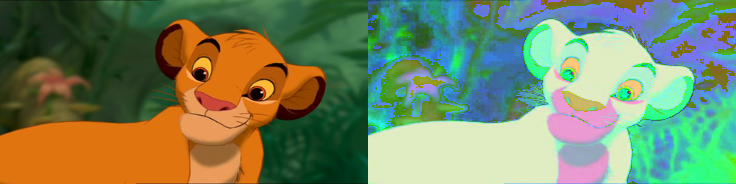
The image data is assumed to be in the range of (0, 1).
- Parameters:
- Return type:
- Returns:
HSV version of the image with shape of \((*, 3, H, W)\). The H channel values are in the range 0..2pi. S and V are in the range 0..1.
Note
See a working example here.
Example
>>> input = torch.rand(2, 3, 4, 5)
>>> output = rgb_to_hsv(input)  # 2x3x4x5
- kornia.color.hsv_to_rgb(image)[source]#
Convert an image from HSV to RGB.
The H channel values are assumed to be in the range 0..2pi. S and V are in the range 0..1.
- Parameters:
image (
Tensor) – HSV Image to be converted to HSV with shape of \((*, 3, H, W)\).- Return type:
- Returns:
RGB version of the image with shape of \((*, 3, H, W)\).
Example
>>> input = torch.rand(2, 3, 4, 5)
>>> output = hsv_to_rgb(input)  # 2x3x4x5
Modules#
- class kornia.color.RgbToHsv(eps=1e-6)[source]#
Convert an image from RGB to HSV.
The image data is assumed to be in the range of (0, 1).
- Parameters:
eps (
float, optional) – scalar to enforce numarical stability. Default:1e-6- Returns:
HSV version of the image.
- Shape:
image: \((*, 3, H, W)\)
output: \((*, 3, H, W)\)
Example
>>> input = torch.rand(2, 3, 4, 5)
>>> hsv = RgbToHsv()
>>> output = hsv(input)  # 2x3x4x5
- class kornia.color.HsvToRgb(*args, **kwargs)[source]#
Convert an image from HSV to RGB.
H channel values are assumed to be in the range 0..2pi. S and V are in the range 0..1.
- Returns:
RGB version of the image.
- Shape:
image: \((*, 3, H, W)\)
output: \((*, 3, H, W)\)
Example
>>> input = torch.rand(2, 3, 4, 5)
>>> rgb = HsvToRgb()
>>> output = rgb(input)  # 2x3x4x5