
TinyViT#
Image classification Detection
TinyViT is a family of small vision transformers (5M, 11M and 21M parameters) distilled from large teachers on
ImageNet-22k. Kornia’s TinyViT ships the ImageNet-1k classification heads, so it
works out of the box as a classifier, and its backbone is the image encoder behind MobileSAM.
Run it#
import torch
from kornia.enhance import normalize
from kornia.io import load_image
from kornia.geometry import resize
from kornia.models.tiny_vit import TinyViT

image = resize(load_image("panda.jpg")[None], (224, 224))  # (1, 3, 224, 224) float in [0, 1]
# the checkpoints were trained on images normalized with the ImageNet mean and standard deviation
image = normalize(image, torch.tensor([0.485, 0.456, 0.406]), torch.tensor([0.229, 0.224, 0.225]))

model = TinyViT.from_config("5m", pretrained=True).eval()  # '5m', '11m' or '21m'; ImageNet-1k head
with torch.no_grad():
    logits = model(image)  # (1, 1000)

top5 = logits.softmax(-1).topk(5)
print(top5.indices, top5.values)  # ImageNet class ids and probabilities
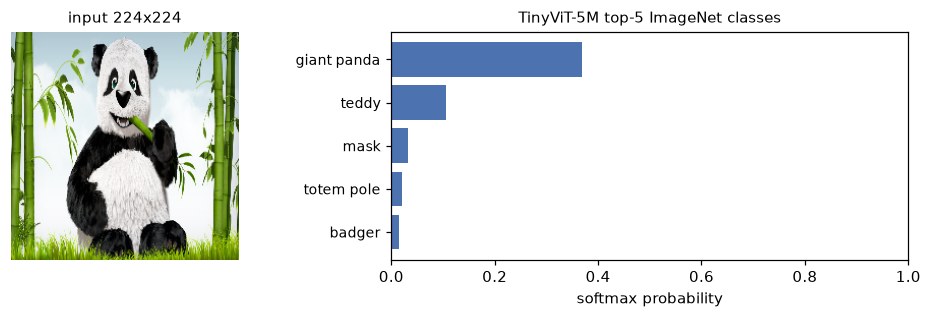
Top-5 ImageNet classes predicted by TinyViT-5M for the input on the left.#
pretrained also accepts 'in22k' and, for '21m', the higher-resolution 'in1k_384' and
'in1k_512' checkpoints. pretrained=True picks them for an img_size of at least 384 or 512, and they are
built with the windows they were trained with, window_sizes=[12, 12, 24, 12] and [16, 16, 32, 16]; named
explicitly, they build at the img_size you pass (224 by default), so pass img_size=384 or 512 to run
them at their resolution. Every other model keeps the 224-px windows [7, 7, 14, 7] at any img_size, unless
you pass window_sizes=, and the attention biases are interpolated only when the windows differ from the
checkpoint’s. img_size must be a multiple of 32 and the input img_size square (sides down to
img_size - 7 round to the same token grid; other sizes raise ValueError), and accuracy is not preserved away
from a checkpoint’s resolution: on the panda above, TinyViT-5M’s probability of the right class drops from 0.37 at
224 px to 0.02 at img_size=256. The ImageNet-22k checkpoint carries a 21841-class head, so load it with
TinyViT.from_config("5m", pretrained="in22k", num_classes=21841): with the default num_classes=1000 the
head does not match, is reset to zeros with a warning, the model returns all-zero logits, and it stays in training
mode as a backbone to fine-tune. For feature extraction replace the head and switch to evaluation mode:
model.head = torch.nn.Identity() makes the model return the pooled embedding, and model.eval() makes it
independent of the rest of the batch.
Paper#
TinyViT: Fast Pretraining Distillation for Small Vision Transformers
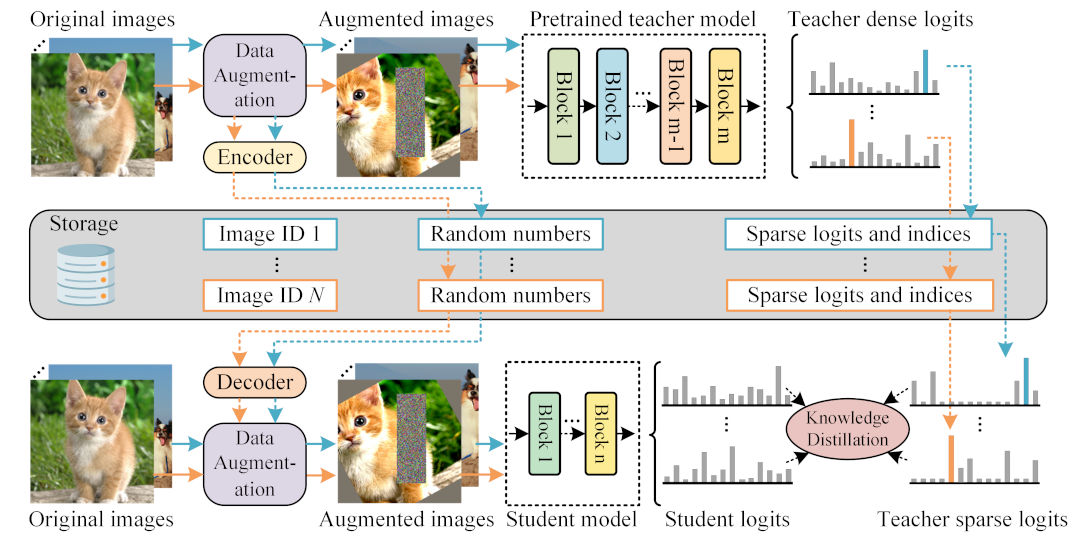
Abstract: Vision transformer (ViT) recently has drawn great attention in computer vision due to its remarkable model capability. However, most prevailing ViT models suffer from huge number of parameters, restricting their applicability on devices with limited resources. To alleviate this issue, we propose TinyViT, a new family of tiny and efficient small vision transformers pretrained on large-scale datasets with our proposed fast distillation framework. The central idea is to transfer knowledge from large pretrained models to small ones, while enabling small models to get the dividends of massive pretraining data. More specifically, we apply distillation during pretraining for knowledge transfer. The logits of large teacher models are sparsified and stored in disk in advance to save the memory cost and computation overheads. The tiny student transformers are automatically scaled down from a large pretrained model with computation and parameter constraints. Comprehensive experiments demonstrate the efficacy of TinyViT. It achieves a top-1 accuracy of 84.8% on ImageNet-1k with only 21M parameters, being comparable to Swin-B pretrained on ImageNet-21k while using 4.2 times fewer parameters. Moreover, increasing image resolutions, TinyViT can reach 86.5% accuracy, being slightly better than Swin-L while using only 11% parameters. Last but not the least, we demonstrate a good transfer ability of TinyViT on various downstream tasks. Code and models are available at microsoft/Cream.
Tasks: Image Classification, Object Detection
Datasets: ImageNet, MS-COCO