
HardNet#
Local feature descriptor MIT
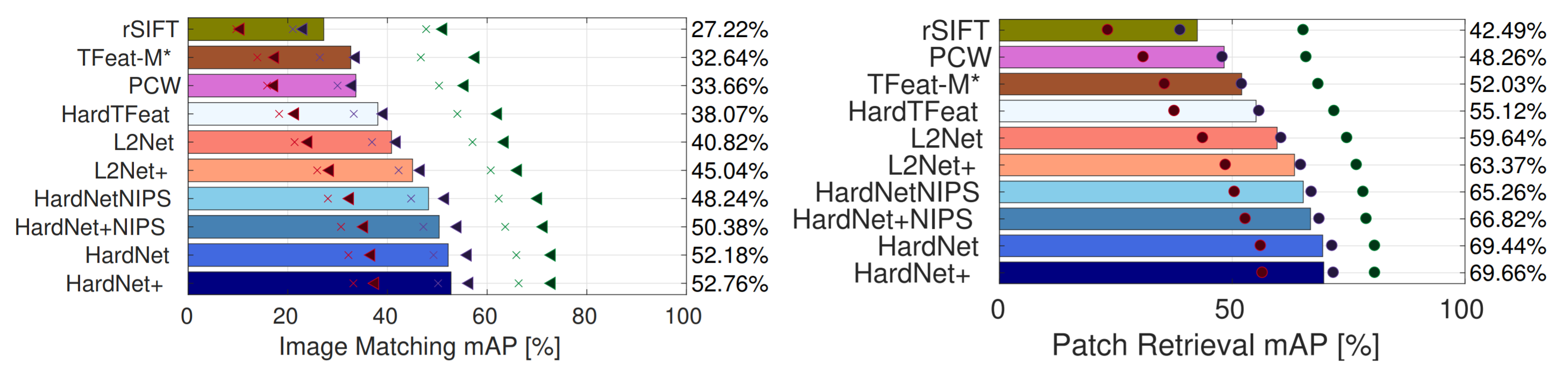
HardNet turns a 32×32 grayscale patch into a 128-dimensional L2-normalised descriptor, the same size as SIFT
but trained with a hard-negative margin loss. HardNet is the descriptor only: pair it with
a detector such as KeyNetDetector, extract patches from the local affine frames and match
the descriptors with match_snn().
Run it#
import torch
from kornia.color import rgb_to_grayscale
from kornia.feature import HardNet, KeyNetDetector, extract_patches_from_pyramid, get_laf_center, match_snn
from kornia.io import load_image

gray1 = rgb_to_grayscale(load_image("church_1.png")[None])  # (1, 1, H, W)
gray2 = rgb_to_grayscale(load_image("church_2.png")[None])

detector = KeyNetDetector(pretrained=True, num_features=1500).eval()
hardnet = HardNet(pretrained=True).eval()
with torch.no_grad():
    lafs1, _ = detector(gray1)  # (1, N, 2, 3) local affine frames
    lafs2, _ = detector(gray2)
    patches1 = extract_patches_from_pyramid(gray1, lafs1)[0]  # (N, 1, 32, 32)
    patches2 = extract_patches_from_pyramid(gray2, lafs2)[0]
    desc1, desc2 = hardnet(patches1), hardnet(patches2)  # (N, 128), L2-normalised
    dists, idx = match_snn(desc1, desc2, th=0.9)  # (M, 1) distances, (M, 2) index pairs

pts1 = get_laf_center(lafs1)[0, idx[:, 0]]  # (M, 2) matched (x, y) in image 1
pts2 = get_laf_center(lafs2)[0, idx[:, 1]]

Eight of the KeyNet patches and their HardNet descriptors (left), and the second-nearest-neighbour ratio matches between the two views (right).#
HardNet8 is the wider follow-up trained on more data, and
LocalFeature bundles detector, orientation, shape and descriptor into one module
(see KeyNetHardNet).
Paper#
HardNet: Working hard to know your neighbor’s margins: Local descriptor learning loss
Abstract: We introduce a novel loss for learning local feature descriptors which is inspired by the Lowe’s matching criterion for SIFT. We show that the proposed loss that maximizes the distance between the closest positive and closest negative patch in the batch is better than complex regularization methods; it works well for both shallow and deep convolution network architectures. Applying the novel loss to the L2Net CNN architecture results in a compact descriptor – it has the same dimensionality as SIFT (128) that shows state-of-art performance in wide baseline stereo, patch verification and instance retrieval benchmarks. It is fast, computing a descriptor takes about 1 millisecond on a low-end GPU
Tasks: Image Retrieval, Patch Matching
Datasets: Oxford5k, HPatches, Oxford-Affine
Conference: NeurIPS 2017
Licence: MIT